Fillings, Crowns, and Bridges
One of the most common types of dentistry that I do in my practice involve fillings, crowns, and bridges. My philosophy about these three modes of treatment revolves around the concept of “nooks and crannies”. When you have a nook or a cranny in or around a tooth, there exists a “space” that can potentially harbor bacteria.
Cavities
Basically, bacteria (on teeth) need three things to live:
1. Sugar
2. Time
3. “A Nook”
The first two things are within the control of the person. For example, if you slowly sip non-diet sodas all day long, you are providing bacteria with lots of sugar and lots of time.
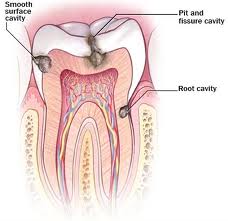
Bacteria are smart. Bacteria eat that same sugar you eat. They use it to live and thrive. Since the by-product of eating sugar is acidic in nature, this allows bacteria to further erode tooth structure, creating an even BIGGER nook or cranny.

(This process of “nook formation” is what people refer to as “A CAVITY”.)
So, when you drink soda all day long, you are giving bacteria plenty of time to form these cavities.
(I’m not condoning drinking soda, but if you have to have one, then slam it real quick, and brush your teeth afterwards!)
So, once the “Nook” is already present, either as a result of natural anatomy, a crack, a fractured tooth, or actual bacterial “cavity” formation, it then becomes the responsibility of the dentist. People can not control or change the nicks and grooves that may exist in a tooth. It is the dentist’s job to find the nooks, document them, and restore them to smooth, free flowing anatomy.
When a person has a “cavity”, bacteria (which feed on sugar) release their by-products onto the tooth. These by-products soften the tooth, eroding it away, and allow the bacteria to burrow further into the tooth.

Fillings
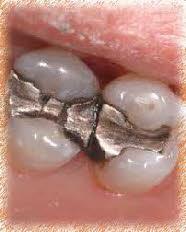
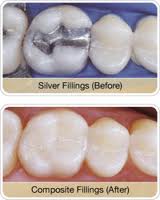
The two most common types of “restorations” for small nooks (ie. when there is less than 50% of tooth structure lost) are Amalgam or composite fillings. Amalgams are the “silver” looking fillings (as seen to the right) which, yes, contain mercury. Composites or “Resin Bonding” are tooth colored fillings that can be matched to an almost exact color of the tooth. Ninety five percent of the restorations I do in my practice are composite bonding.
“Bonding” is arguably one of the biggest technological advances to ever happen in dentistry. Bonding is just a fancy way of saying we’ve figured out how to glue something to a tooth. An amalgam passively sits in a tooth and is held in by dovetails and undercuts; whereas, a composite is physically attached to the tooth. Although amalgams are durable and have many positive long term characteristics, composites have opened the door to things like veneers, esthetic anterior fillings, and many other aspects of cosmetic dentistry. Moreover, cosmetic dentistry would not exist if it were not for Bonding.
Crowns
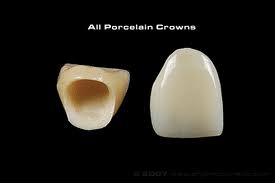
In situations when there is more than 50% of structure lost from a tooth, fillings are prone to breakage, and a “Crown” becomes the treatment of choice.
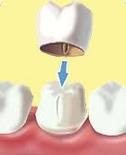
I think of a crown like a belt that physically encircles the tooth 360 degrees and holds it together. With the aid of bonding (internally), a crown will mechanically support a tooth which lacks its own external structure. For example, if a tooth is cracked in a “greenstick” manner (ie. like a line through glass that hasn’t yet separated), then I would remove the crack, bond the tooth together with composite, then crown the tooth as a permanent (and strong!) restoration.
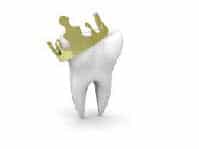
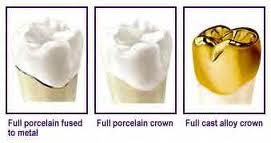
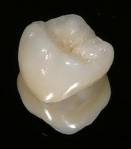
A crown is like a prosthetic “cap” for the tooth. It can be made out of all gold, all porcelain, or “PFM” (porcelain fused to metal alloy). Crowns are extremely strong and provide the tooth with 360 degrees of support. An all porcelain crown or PFM crown can be made to exactly duplicate the appearance of a natural tooth.
Other Reasons To Crown a Tooth
- An entire cusp is lost from a tooth.
- The tooth is cracked.
- The tooth had a root canal.
- Tooth is severely worn due to grinding or parafunction.
- Cosmetic improvement.
- Restore a dental implant.
Bridges
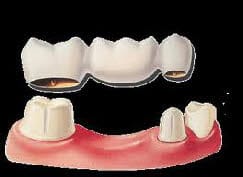
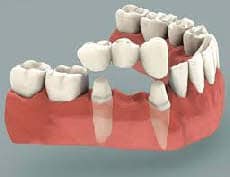
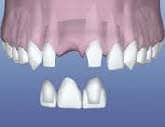
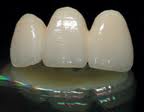
A bridge is like 3 or more crowns fused together internally. They are used when there is one or more missing teeth. There is a porcelain or metal substructure (or skeleton) that supports the missing tooth area. The crowns on the ends are like “caps” supported by teeth and the middle crown is a solid prosthetic replacement for the missing tooth. Bridges are “fixed” ie. the patient can not take it out. In this respect, they are very comparable to implants. It is a nice way to replace a missing tooth (or teeth). It is one way to get a patient back to the esthetics and function they had before any teeth were lost.
The main difference between a bridge and untouched natural teeth is that floss can not pass between the teeth contained in a bridge. Bridge teeth are connected in order to support the missing tooth. I give patients special floss threaders and brushes which allow them to clean under the bridge. Waterpiks are also an excellent way (maybe the best!) to clean under a bridge.
But, a bridge can be completed in a matter of weeks, most insurances cover this form of treatment, and it is a quick (and quality) way to restore a patient back to ideal esthetics and chewing function.