What is a dental implant?
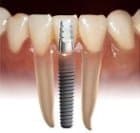
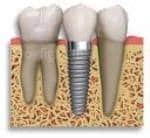
A dental implant is a small threaded screw made out of titanium. Titanium is a “biocompatible” material. This means that bone likes it. Most foreign substances, when placed in the body, cause an immune reaction (ie. a sliver in your finger or a bullet in your gut.) But, with titanium, no immune reaction is generated. In fact, bone actually grows onto the titanium threads
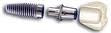
The final implant restoration is made of 3 (sometimes 2) pieces. There is the actual implant. Then, an “abutment” is screwed into the implant with a very specific torque. This is a little peg shaped component that sticks out from the implant. It acts as the structure and support for the crown. The crown is then cemented on top of the abutment with a crown cement.
Certain situations may require the crown to be directly screwed into the implant with no abutment involved.
How is the implant placed?
If you’ve ever screwed a screw into a piece of wood, then you already know the basics of implant placement. First, you drill a pilot hole into wood, to a size slightly smaller than the screw diameter to be placed. Then, you turn your screw into that pilot hole in a clockwise motion engaging the threads. As the screw gets deeper into the wood, the screw exerts force on the wood and holds it in place.
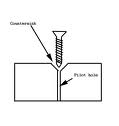
Now, substitute implant for screw and bone for wood. I make a small incision over where the implant is to be placed. Tissue is reflected and bone is smoothed. I have a series of pilot drills I use to create the “osteotomy” or pilot hole. I drill to just shy of the desired implant diameter. The implant is then placed and “screwed in” to a specific torqueing force depending on the density of the bone. I have computers that measure this force because it is very important this is done specifically and correctly. Once the implant is placed, a small cap is placed over the orifice of the implant and the tissue is sutured over the top of the implant, completely submerging it.
Many years ago, I used to place the crown (or temporary crown) on the implant (“load it”) at the time of implant placement. However, with years of experience, I have learned there is a much higher predictability of success if I let the implant heal (after placement) for at least 3 1/2 months before placing the crown. Just ANOTHER example of me becoming more “clinically conservative” with years of experience.
So, I leave the implant under the tissue for 3 1/2 months to allow bone to grow in and around the implant threads, locking it in (termed “osseointegration”).
A second, very minor surgical procedure, is then done uncovering the implant. Using either a laser or a scalpel, I will expose the implant. Finally, a small “healing cap” is screwed into the implant and tissue is sutured around the cap.
I allow 2 weeks for this to heal. The implant can then be treated like a normal tooth requiring an impression and crown fabrication.
Single Implants:
If you are missing one tooth or several teeth, implants offer patients the most functionally and esthetically realistic option for tooth replacement in dental technology today.
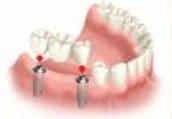
Two (or Four) Implant Retained Denture:
Specifically, one of the most common patient complaints is a poorly fitting or “loose” denture. For many years, these patients’ only option was a “denture reline” or “complete denture remake” which never seems to truly fix the problem. Today, dental implants offer a realistic solution.
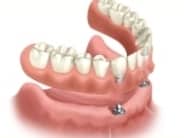
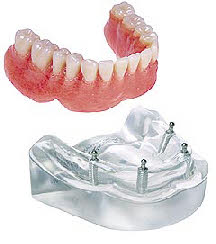
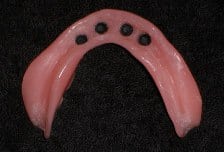
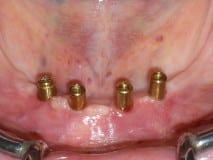
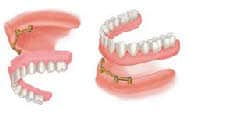
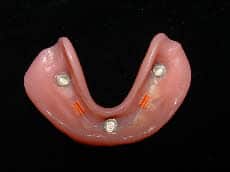
With as few as 2 implants placed in the anterior aspect of the jaw, a dramatic improvement in stability and retention can be achieved. Small clips or female attachments are incorporated into a new denture (or your old denture). This allows the denture to “snap” into place. The patient is able to function with only slight denture movement in the posterior.
Four implants:
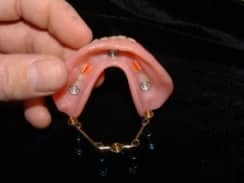
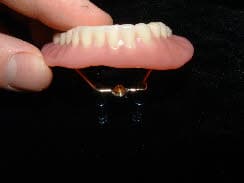
With a minimum of 4 implants, a marked improvement in stability can be achieved over the 2 implant design by use of a titanium or metal bar. The bar is fixed onto the implants with screws. The denture “snaps” (very solidly) onto retentive features incorporated in the design of the bar. This option offers the advantage of complete stability while still allowing the patient to remove the denture for hygiene and maintenance.
Five implants:
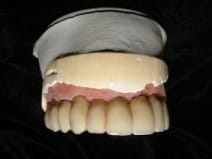
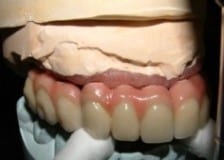
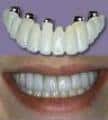
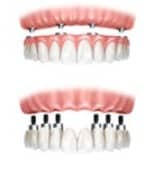
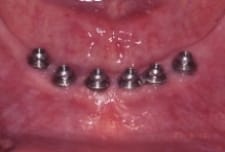
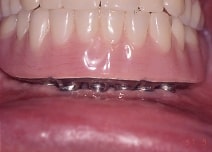
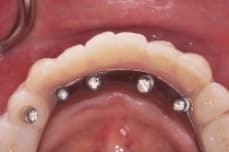
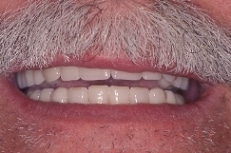
With a minimum of 5 implants (and sometimes four, depending on the situation), the edentulous patient can have a full arch of fixed teeth. This option is perfect for the patient who does not want anything removable. This type of “horseshoe-
Six implants or more:
With a minimum of six implants or more, edentulous patients can enjoy full fixed crowns and bridges as with natural teeth.